
This Is Not Law Enforcement
An octogenarian couple, a man in a chicken suit, and the struggle to reclaim what it means to enforce the law.

On January 26, Ava DuVernay published an excellent essay on this platform titled The Narrative War.
DuVernay was thinking about “the moment when language breaks eye contact with truth.” She asked herself how much she, without realizing, was enabling power by being imprecise with language. When we use words like “law enforcement” to describe the actions of the agents who murdered Alex Pretti in Minneapolis last weekend, Ms. DuVernay reasoned, we become complicit in legitimizing state terror. The language we use is “less of a description and more of some kind of moral shield.”
She wrote:
[W]hen precision disappears, any idea of accountability goes out the window with it. Everything flattens. When we’ve accepted their words, now we’re speaking their language. We’ve accepted their ground rules, their foundational ideas and assumptions. And on their turf, they win.
I think about DuVernay’s words as I read the recent motion for a temporary restraining order (TRO) filed in the District of Oregon by the plaintiffs in a lawsuit against the administration that was brought in November by Jack Dickinson, also known as “the Portland Chicken,” and other peaceful protesters in Portland, Oregon, who have been gathering outside an ICE facility, where they have been met with unrelenting violence.
In the motion, filed on January 27, 2026, Dickinson and other plaintiffs sought to prevent the Department of Homeland Security, “from using excessive force on peaceful protesters at and around the ICE Building.”
This is something people who call themselves “law enforcement” are already prohibited from doing.
By law.
Yet 84-year-old Laurie Eckman, who attended a peaceful protest outside the Portland ICE facility on October 4, 2025, was shot in the head by a DHS officer with some type of munition and walked home “soaked in blood.”
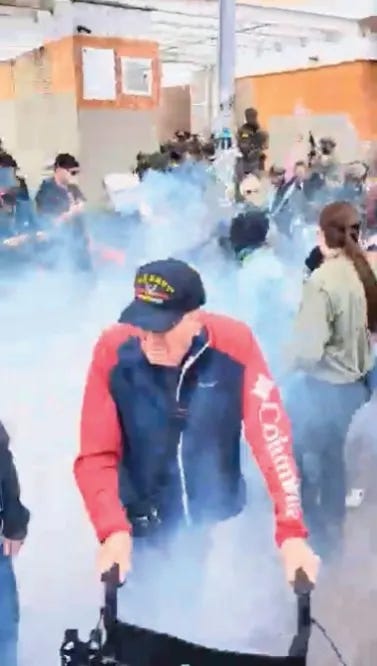
Her husband, Richard, an 83-year-old who walks with the assistance of a walker, was overcome by a blast that “detonated near him and left residue on the walker’s frame, leaving Mr. Eckman feeling targeted, struggling to breathe, and disoriented.”
The Eckmans live in an apartment overlooking Elizabeth Carruthers Park, a few blocks from the ICE building. They have lived in Portland since 1976. They are parents, grandparents, and church members. In her youth, Laurie protested the Vietnam War. Richard joined the Navy and served actively in that same war.
I wonder about how they met, two young people on opposite sides of a conflict that deeply divided our country, how they fell in love. How they ended up moving to Portland. But their sworn declarations, submitted in support of the motion for the TRO, do not detail this past.
They do tell us, however, what motivated them to attend the October 4 protest. Their decision was “spur of the moment.” Looking out their apartment windows at Carruthers Park, they saw a gathering of people with signs supporting immigrants and protesting the administration’s threats to deploy the military in Portland. Richard was especially struck by the visible presence of veterans. He decided to wear a U.S. Navy hat, navy blue with gold lettering. After listening to speeches and chanting, they marched with the assembled crowd to the ICE building, a few short blocks away.
The Eckmans no longer feel safe attending protests at the ICE building or anywhere else federal officers may be present. Laurie worries that the same thing may happen to her again. Richard writes: “I still struggle to understand how officers are able to use guns on peaceful protesters. Guns require people to aim them, and one officer’s aim was directed at my wife’s head.”
The Eckmans and other plaintiffs filed their lawsuit on November 21, 2025. The violence perpetrated by agents against peaceful protesters assembled outside of the Portland ICE Building continues.
The lead plaintiff, Jack Dickinson, a/k/a “the Portland Chicken,” attends protests wearing “a yellow fleece chicken costume with an American flag draped over his shoulders like a cape.” He keeps showing up, despite the fact that federal agents continue to deploy pepper balls, flashbangs, and gas canisters.
Another plaintiff who attended a Martin Luther King Jr. Day sit-in was “maced to the point she could not open her eyes.” Still another was shot in the back with pepper balls that ripped through her jacket. And at peaceful protests in the days following Alex Pretti’s killing, agents aimed their munitions at protesters’ heads and bodies.
The escalating violence by agents at the Portland ICE building was the basis for the plaintiffs’ request for a TRO. They asked the district court to issue an order stopping agents “from using non-trivial amounts of force on people engaged in passive resistance” and “from using crowd-control weapons in dangerous ways that violate their own policies and jeopardize peaceful protesters.”
In support of that request, the plaintiffs submitted the declaration of former CBP Commissioner Gil Kerlikowske, a 52-year law enforcement veteran who has overseen the policing of hundreds of protests, including many far larger and more volatile than those in Portland.
Kerlikowske’s conclusions were unambiguous.
DHS, he found, had exhibited “a consistent pattern of deploying excessive force,” including against people “who pose no threat to law enforcement.” Less-lethal munitions were being used indiscriminately. Tear gas was being deployed without warning. Crowd-control weapons were being misused in ways that were “highly dangerous to everyone present.”
Kerlikowske explained what actual law enforcement looks like in this context: establishing a perimeter, issuing warnings, making targeted arrests when necessary. Less-lethal force, he wrote, is reserved for imminent threats. Such weapons, he noted, are “capable of killing people” and should only be used when “other lesser levels of force have failed or are unavailable”—not fired indiscriminately into crowds.
Nothing he reviewed reflected those standards.
What Kerlikowske described was not merely a failure of tactics, but a distortion of language itself.
Violence against peaceful protesters at the Portland ICE Building is not law enforcement.
The permission that ICE has given itself to forcibly enter people’s homes without a judicial warrant is not law enforcement.
The murders of Keith Porter, Jr. in Los Angeles and Renée Good and Alex Pretti in Minneapolis, are not law enforcement.
The deaths of 32 people in ICE custody in 2025 are not law enforcement.
Despite their fear, after receiving an invitation from their church to “a family-friendly event committed to nonviolence,” the Eckmans recently decided to risk protesting again, attending an interfaith gathering at Carruthers Park on January 31. After assembling in the park, the crowd walked toward the ICE building. The Eckmans were separated from one another. Laurie and a group of fellow church members stopped half a block from the ICE building, fearful of getting too close. Tear gas was deployed repeatedly, filling the air and overcoming them both. Laurie described walking through multiple tear gas clouds as she tried to get away:
I held on to a person next to me as I walked and held a tissue over my nose. I could not keep my eyes open, my face stung, and it was hard to breathe. People were retching, vomiting, and crying.
The Eckmans filed supplementary declarations detailing these experiences. And yesterday, February 3, District Judge Michael H. Simon granted the plaintiffs a 14-day TRO, setting a March 2 hearing on their motion to make the TRO permanent.
“The Court finds that the repeated shooting and teargassing of nonviolent protesters at the Portland ICE Building will likely keep recurring,” Judge Simon wrote in a 22-page opinion.
Under the TRO, no officer may direct or use chemical or projectile munitions, including pepper-ball or paintball guns, pepper or oleoresin capsicum spray, tear gas, flash-bang grenades or other chemical irritants, rubber bullets or other less-lethal weapons against a person unless that individual poses an “imminent threat of physical harm” to a law enforcement officer or someone else.
It took a federal court order to say what should have been obvious: that firing chemical weapons into peaceful crowds is not “crowd control,” that shooting an 84-year-old woman in the head is not “public safety,” that violence does not become legitimate because the people inflicting it wear uniforms.
Ava DuVernay warned that when language breaks eye contact with truth, accountability disappears with it.
For months outside the Portland ICE Building, that break has been literal.
The Eckmans know this now. Laurie lives with a scar where a projectile struck her skull. Richard wonders how what led people who have taken the same oath he did as a young sailor to defend the Constitution to open fire on his neighborhood.
Their declarations, sworn under penalty of perjury, forced language back into alignment with reality.
Only then did the law speak clearly enough to restrain power.
Only then did language make eye contact with truth.
Thank you for keeping the focus on the truth. This is not law enforcement. It is extralegal or extrajudicial violence by agents acting under the aegis of the presidential administration. Rule by force not even rule by law and certainly not rule of law. This may attempt to be accurate and precise. Hoping someone has even better language